Monday, November 20, 2023

India's 10 year draught in ICC World Cricket Tournaments

India's failure yet again to cross the finish line having bowed out to Australia in front of a jam packed voracious home crowd raises lot of questions and speculations with regard to India's ability to claim victory in major world cricketing tournaments. This unfortunate pattern has been repeating for far too long exposing the frailties and one doubts if it's a psychological issue as a team laden with such strength and skill sets who performs admirably well right through a competition manages to capitulate when it comes to the high pressure knock out games.

It is now a span of 10 completed years since India has won anything of repute with their last major victory coming in the ICC Champions Trophy 2013. There are 3 more marquee world events expected to play out within the next one and half years comprising of the T20 World Cup in mid 2024 played in the US & Caribbean followed by the ODI Champions Trophy taking place in Pakistan in early 2025 followed by the 3rd cycle of the World Test Championship in England during the first half of 2025. In this interim period between 2013 to 2023, almost all the Test playing nations have captured a title barring South Africa and Bangladesh. This certainly isn't something to be proud of for a country rich in cricketing culture and heritage.

Let's briefly summarize the big ticket world cricketing events that have taken place since the ICC Champions Trophy in England, 2013.

1) 2014 T20 World Cup - Host Bangladesh - Winner Sri Lanka

2) 2015 ODI World Cup - Host Australia - Winner Australia

3) 2016 T20 World Cup - Host India - Winner West Indies

4) 2017 Champions Trophy - Host England - Winner Pakistan

5) 2019 ODI World Cup - Host England - Winner England

6) 2021 World Test Championship - Host England (Final) - Winner New Zealand

7) 2021 T20 World Cup - Host UAE (India holding Rights) - Winner Australia

8) 2022 T20 World Cup - Host Australia - Winner England

9) 2023 World Test Championship - Host England (Final) - Winner Australia 

10) 2023 ODI World Cup - Host India - Winner Australia

Thus one can see there have been regular major events held almost every year with India having plenty of opportunities but not being able to triumph in any of the 10 events since the last ascendancy coming way back in 2013. Former players, analysts, pandits and fans have been quite raucous with some even calling out for a major reshuffle in the side especially in the T20 format advocating for bringing in more fresh legs and eliminating some of the older folks. 

All this might seem to be a bit too harsh considering the team overall did play some spectacular cricket in the recently concluded ODI world cup with just one off day plunging their fortunes. The criticism may seem to be a bit too far fetched but one thing is pretty clear that people have short memories and it's only the victories that count at the end of the day. Actually speaking it might seem to be a bit of a misnomer but factually speaking India have actually been the stand out team in ICC events over the past decade. They have virtually done exceptionally well in almost all the big events but alas without any silverware to showcase. In majority of the cases, India have just been short of a match or two from winning the whole tournament. The biggest flaw has been that the team has not been able to seize the initiative and have lacked the killer instinct in the must win do or die knock out games. Sadly, India will have to abide with the title of perennial chokers till they get this monkey off the back by actually winning something of repute.

Sharing a brief synopsis of India's performances down the years in the ICC World Events.
2014 T20 World Cup:
India entered the finals and were considered firm favorites to romp home after their stellar victory over South Africa in the semi finals. The final opponents were Sri Lanka, the side India defeated in the 2011 ODI World Cup. The Lankans were firm underdogs but pulled off a spectacular showing in the finals to topple India. India's batting which was clicking match after match grossly underperformed in the final having scored just 130 in the allotted 20 overs having lost just 4 wickets. This was too meagre a total for the Lankans who managed to get there without much of a hassle.

2015 ODI World Cup:
India managed to reach the semi finals without battling a sweat. In fact they were the only unbeaten side along with New Zealand till that stage winning all 6 of their group games along with sweeping aside the Bangladeshis in the quarter final encounter. But when it came to the big match semifinal against the hosts, India came a cropper caving in rather tamely. Australia put up a 300 plus score on the board with India never in the hunt losing by almost a three figure mark.

2016 T20 World Cup:
This was a home World Cup for India and the performance in the beginning was kind of muted. They however stepped up with a closely fought must win encounter against Bangladesh followed by a sizzling closely fought quarter final win over the Aussies setting up a semi final showdown against the Windies at the Wankhede. India put up a score of almost 200 and looked to drive home the advantage but this time the bowling didn't step up when needed allowing the Windies to go surging past the total. This was a great opportunity lost to win a world cup title at home.

2017 Champions Trophy:
Another tournament dominated by India till they came undone pretty badly in the finals against arch rivals Pakistan. India had in fact comfortably hammered the same opposition in the group stage match but when it came to the final, India were totally outclassed losing by a mammoth 180 run margin. India had again come in as the favorites for the final but the manner of defeat was pretty searing to say the least.

2019 ODI World Cup:
This was a 10 team edition with each team getting to play each other and the top 4 teams making it to the semi finals. India finished right on top of the 10 teams and got to play the Kiwis who had finished 4th. India again went into the semi finals as firm favorites but again swallowed the opportunity by failing to chase a reasonable score put up by New Zealand in a rain marred game. The batting totally let them down with the team losing wickets in a heap at the beginning. Jadeja and Dhoni did offer a great fightback but it was too much to claw at and in the end it was a bitter pill to swallow for India. This was perhaps one of the best chances missed by India to claim a World Cup in England since their maiden memorable victory way back in 1983. 

2021 T20 World Cup:
This was perhaps the only time India never really showed up in a world event over the last many years. India succumbed to Pakistan finally in a World Cup match losing their golden run that too in an abject embarrassing manner going down by 10 wickets. In the other must win game against their nemesis Kiwis, India's batting faltered again allowing New Zealand to win easily. Thus, India was knocked out of the tournament before the semifinals and it was quite a major disappointment. The event was supposed to be staged in India but got moved over to the Emirates due to the Covid factor with India still retaining the hosting rights for the event.

2021 World Test Championship: (2019-2021 Window)
This was the first ever Test Championship to have been staged after years of contemplation. The top two sides were to meet in the final and India were placed right at the top with an impressive array of victories in the test format during the window of 2019-2021 including a famous back to back series win down under against the Aussies. India again were tipped as favorites going into the final but again came undone against a methodological and resolute New Zealand side. This was the first world test championship to be conducted and it can be said that India certainly missed a golden chance to go atop the honors board.

2022 T20 World Cup:
Another World Cup and another disappointment. India won the game of the tournament against their arch rivals Pakistan and easily made it to the semifinals again topping their group. But it was an absolute day to forget for the Indians in the semi finals as a marauding England side made mincemeat of India's target barraging past the total without battling an eyelid not even losing a solitary wicket in the process. Australian conditions were suiting the Indian batsman and it looked like something huge was finally coming India's way but alas it was again not to be. 

2023 World Test Championship: (2021-2023 Window)
This was the second time the World Test Championship was being staged and India again found themselves among the top two teams and this time it was a new opponent in the form of Australia who were appearing in their first WTC final. India had just recently defeated the same side in a home test series and would have gone in with some confidence. But some poor reading of the conditions along with blatant selection mistakes cost India the match right on the first day after initiating the opposition into bat. It was again a wonderful opportunity missed through the door as India again earned the tag of being runners up for a second straight showing.

2023 ODI World Cup:
This would arguably rank as the biggest colossal monumental disappointment especially considering the way India had gone right through the tournament literally dispatching, demolishing and decimating all the opponents who had come by their wayside. This time they managed to overcome the Kiwis in the semifinal and taken their win count to 10 wins on the trot. But come the all important final when India went in as clear favorites, the ship sank once again in what was the biggest game of their lives in front of a massive home crowd. The pitch was perhaps the biggest deterrent but once again cometh the moment, India just caved into the pressure and succumbed meekly against an Aussie side who further cemented their legacy as the greatest white ball champions in the history of cricket. This was a complete all encompassing performance with almost not an iota to criticize but it all unfortunately fell apart in the marquee final once again putting an abrupt halt to what had been an absolutely impressive show until then.

India's 3 major world titles in 2007, 2011 and 2013:
India did win 3 major titles viz the T20 World Cup, ODI World Cup and the Champions Trophy all within the span of 2007-13. This might sound like a golden period but not many can recall that India faltered big time in all the other world tourneys around that ball park. After winning the inaugural T20 World Cup in 2007, India failed to even reach the semi finals in the next 3 editions that took place in 2009, 2010 and 2012. India also failed to muster up at the 2009 Champions Trophy by not being able to reach the knock out phase in continuation to what happened at home three years prior in CT 2006. But what matters is when it really came down to being noticed, India under the astute tutelage of Mahendra Singh Dhoni were able to claim 3 major world events within a short span by establishing to go all the way. A young India did the unthinkable by claiming the inaugural T20 World Cup. India were able to soak all the pressure and raised their game in the crucial stages to win the home ODI World Cup in 2011. India also managed to rake up a Champions Trophy victory by defeating the hosts England in the final in a rain curtailed 20 over game. 

Conclusion:
Thus stats and performance points out that India have not at all been a bad side when it comes to the major cricketing events conducted over the last decade. There have been some exceptional efforts coupled with plenty of individual brilliance but however when it really came to the crunch India as a team have not been able to deliver. It feels like a "Catch 22" situation but India have virtually been just a game or two away from winning almost all the major ICC events. It is definitely an irony that India has not been able to convert even one of those into a celebration. It has to be said that India has been poor when it comes to the clutch and this has happened a little way too often than expected. Nowadays, chances of winning big tournaments are higher for the players as many world cups keep happening routinely unlike the good old days when there was only one ODI world cup scheduled every 4 years. India have had too many one off bad days and every time that has come to haunt at the back end of the tournament unfortunately stalling their progress further. It may be argued that it's just a matter of time but India do have to measure and step up big time in the crucial stages. This current defeat in the home ODI World Cup of 2023 will rankle them no end as just one bad game curtailed their entire array of sterling performance right through the tournament. The pressure is only going to be all the more immense going forward with plenty of things to ponder like handling of senior players and getting the right mix in place for all 3 formats - Tests, ODIs and T20s. Hoping India is somehow able to get the mickey off the back and claim an illustrious multi nation cup victory very soon. It may be an irony but the fact is that consistent showings count for nothing because ultimately what sticks in memory is who wins at the end of the day.

Sunday, June 18, 2023

Designated Padas - Special spots to be aware of in a Horoscope

A broad spectrum of a horoscope consists of 12 houses represented by 12 different zodiac signs. However when it comes to dividing a zodiac signs into parts, the Navamsa or the D9 variation adds an extra colour when looked at from the purview of vedic astrology. Each of the Zodiac signs thus are bifurcated into 9 equal parts measuring a zone of 3 degrees 20 minutes making up 108 parts (12*9) in totality.

When it comes to analyzing these Padas, there are certain of them which tend to be auspicious and a few inauspicious. There are different characterizations under which these padas can be slotted into which are pretty important to look at in a horoscope. Some of them also overlap with each other but it's good to note and understand these specific padas as they can be quite useful in the analysis of a horoscope. Many a time we don't tend to reflect on these as they are much in number and quite difficult to keep a tab at. But certainly they can give a divergent flavour when looked at from the lens of a horoscope.

The different padas to be aware of in a horoscope which ultimately yields it's result in the D9 or Navamsa chart are as below:

- Vargottama Amsa Pada

- Pushkara Amsa Pada

- Gandanta Amsa Pada

- Tyajya Amsa Pada

- Duritha Amsa Pada 

- Mrityu Amsa Pada

Let's briefly look at all of the above and understand the specific spots in a horoscope where they occur:

Vargottama Amsa Pada:
Vargottama is used to describe a position where a planet attains the same placement in the main D1 Rasi chart as well as the subsequently derived D9 Navamsa chart. Vargottama is applicable in all the Divisional charts but is particularly looked at with importance in the Navamsa division. As they are placed in the same sign in both D1 and D9, it is said to indicate a harmonious alignment and is a position of strength known to amplify the results. It is said to have a major influence in an individual's horoscope. Though it tends to seemingly connote a position of strength, it needs to be looked at from a broader perspective and with a touch of caution. For instance the Ascendant Lord in Vargottama can indicate vigour and energy for the individual but however the 6th Lord say placed in Vargottama can influence 6th house negative matters which may not always be a good thing. Brihar Parashara Shastra mentions Vargottama as a significant tool in computing strength of a planet.

Vargottama happens in each zodiac sign in a particular part out of the 9 parts. In a movable zodiac sign the 1st part becomes a Vargottama whereas in a Fixed zodiac sign every 5th part becomes a Vargottama and in a Dual zodiac sign, the 9th part ends up being in Vargottama. Hence there are a total of 12 Vargottama Pada's out of a total possible 108 Padas making up the Rasi chart.

Pushkara Amsa Pada:
Pushkara are supposed to be those areas within a zodiac which are said to enhance the qualities of a planet. It denotes nourishment and when any entity is placed in a Pushkara pada, it is said to indicate a sweet spot. Pushkara in Sanksrit means blue lotus and these Pushkara Amsa's fall in special designated degrees that tend to bring growth, luck and auspiciousness. Though some of the major classics have no reference of Pushkara Amsa, Vidhya Madhaveeyam and Jathaka Parijatha do have a passing mention of these.

Pushkara Pada takes place in 2 specific parts in each zodiac sign leading to a total of 24 Pushkara Pada's in total. In a fire sign viz Aries, Leo and Sagittarius it happens to be the 7th and 9th part. For Earth signs viz Taurus, Virgo and Capricorn it is the 3rd and 5th part. For Air signs it is the 6th and 8th part whereas for Water signs it is the 1st and 3rd part. In essence 24 out of 108 total padas happen to be Pushkara Amsa Padas.

Note: Since the topic of Pushkara Amsa was mentioned, it would also make sense to note about the topic of Pushkara Bhaga which are said to be one specific degree in each zodiac sign that are said to be extremely auspicious. Jathaka Parijatha denotes the following degrees to be Pushkara Bhaga for the zodiac signs from Aries to Pisces viz 21°, 14°, 18°, 8°, 19°, 9°, 24°, 11°, 23°, 14°, 19°, 9°. In the book Navamsa Astrology however Pushkara Bhaga degrees are a little different and is believed to be obtained from Poorva Kalamrita and as per this 21° of a fire sign, 14° in an Earth sign, 24° in a Air sign and 7° in a Water sign are said to be Pushkara Bhaga 

Gandanta Amsa Pada:
Gandanta are the junction points which take place in the transition between water to fire signs. Gandanta can be said to be a point of danger and if a planet is placed in the Gandanta zone, it is said to be inauspicious causing negative things to befall upon the path of an individual. Gand means 'knot' and Anta means 'end' which can loosely be translated to as knot being tied that is difficult to unshackle. This is said to be connected at a soul level and hence very deep. It is ideal if no planet is placed in the Gandanta zone and especially that of the Moon as it signifies the mind which makes it difficult to overcome.

Gandanta Pada takes place only in the fire and water signs with the first of the fire signs and the last of the water signs initiating the Gandanta zone. Hence there are only 6 parts out of a total 108 parts which fall in Gandanta. Also in general it is said that only the last two ghatis and the first two ghatis of the Nakshatra falling in water and fire signs respectively to be extremely intricate and sensitive points which when converted in degree terms denote the following span viz:
29° 23' 20'' of Pisces, Cancer, Scorpio to 0° 26' 40'' of Aries, Leo, Sagittarius  

Tyajya Amsa Pada:
There are selective Nakshatra Padas in each of the 12 zodiac signs where planets are said to lose their potency and become ineffective when seated within that designated spot of 3°20'. These are also termed as Poojya Pada that translates to zero point and said to denote a cursed or poisoned space. Hence if any of the planets falls in this area, it can attract negative vibrations and misfortune.

Tyajya or Poojya Pada takes place in one particular pada in each of the 12 zodiac signs. Hence there are a total of 12 Tyajya Padas out of 108. In 4 of the zodiacs viz Aries, Taurus, Virgo and Sagittarius. Tyajya Pada falls in the very 1st pada whereas in 4 of the zodiacs viz Gemini, Leo, Libra and Aquarius, Tyajya Pada falls in the middle 5th pada and in the remaining zodiacs viz Cancer, Scorpio, Capricorn and Pisces, Tyajya Pada falls in the last 9th pada.

Duritha Amsa Pada:
The Nakshatras are said to be divided into 3 groups - Creation, Maintenance and Destruction. The First Nakshatra beginning from Ashwini is Srishti (Creation), 2nd Bharani is Sthiti (Maintenance) and 3rd Krithika is Samhar (Destruction). The sequence is said to repeat from the 4th Nakshatra onwards until the last 27th Nakshatra. The Samhara Nakshatras which are those that occur in multiples of 3 are said to initiate Durithamsa. Any planet placed in Durithamsa is known to be inauspicious and capable of causing trouble, and despair.

Duritha Pada takes place only in the Nakshatras whose star lord happens to be Sun, Rahu and Mercury. These fall in the Earth, Air and Water signs only and Durithamsa is devoid of Fire signs. Though there are 4 padas in each of these Nakshatras, it is only the 3rd and 4th pada that attract the sensitivity of Durithamsa Pada and they happen to all fall specifically only in the zodiac sign of Aquarius and Pisces in the D9 Navamsa chart. Hence there are a total of 18 Duritha Amsa Padas out of 108 Padas (2 in each of the 3 earth, air and water signs).

Mrityu Amsa Pada:
There is also a mention of Mrityu point where it's said that when planets are placed in these spots they can suck the signification and cause a killing effect. There is no much information available of this in any specific text. However these are also being documented for reference purpose.

Summary of Designated Padas:
Listed below is a tabular representation of the specified zones in which Vargottama Amsa, Pushkara Amsa, Gandanta Amsa, Tyajya Amsa, Duritha Amsa and Mrityu Amsa takes place.


Overall Analysis:
From a broad overview we can state Vargottama and Pushkara to be more favorable as compared to Gandanta, Tyajya, Duritha and Mrityu which all indicates malicious effects. There are only 3 particular padas out of 108 which happen to be both Vargottama & Pushkara that happen to be Rohini 2nd Pada in Taurus sign, Punarvasu 
4th pada in Cancer sign and Uttara Ashada 1st pada in Sagittarius sign. Likewise there are only 3 particular parts out of 108 which fall in the ambit of being Gandanta, Tyajya and Durithamsa all at the same time and these are Ashlesha 4th pada in Cancer sign, Jyeshta 4th pada in Scorpio sign and Revathi 4th pada in Pisces sign. Out of this Revathi 4th pada alone happens to be a Vargottama pada also and ascertains strength. Ashwini 1st pada which happens to be the next pada after Revathi 4th pada also happens to be Vargottama pada and also a Gandanta and Tyajya Pada but however does not fall into the category of Durithamsa pada. None of the Pushkara Pada happen to be Gandanta or Tyajya Padas however 6 of these 24 Pushkara padas unfortunately end up becoming Durithamsa Padas viz the 4th padas of the Samhara Nakshatras of  Krithika, Aarudra, Uttara Phalguni, Swathi, Uttara Ashada and Satabisha. 2 of the Pushkara Pada also fall into the category of Mrityu Pada namely Krithika 4th pada and Uttara Bhadrapada 2nd pada. Poorva Phalguni 1st pada gathers strength on being Vargottama but however loses its sheen because it's a Tyajya pada and same is the case for Satabisha 3rd pada which gains strength due to Vargottama but is exposed to the cursed Tyajya Pada as well as the harmful Duritamsa Pada.

Saturday, June 10, 2023

Market Capitalisation - Large, Larger and Largest

There are many determinants when it comes to valuing the size of a company which could be in terms of revenues, profits, cash, foothold or a host of factors but the single biggest contributor happens to be Market Capitalisation or what is loosely termed as M-Cap. Presently, the most valued company in the world happens to be Apple and it's because of the market value that it has ascertained while being traded in the bourses. However it should be noted that there are closely held companies which are not listed in the stock exchanges and for these market capitalisation will not be available or be applicable.

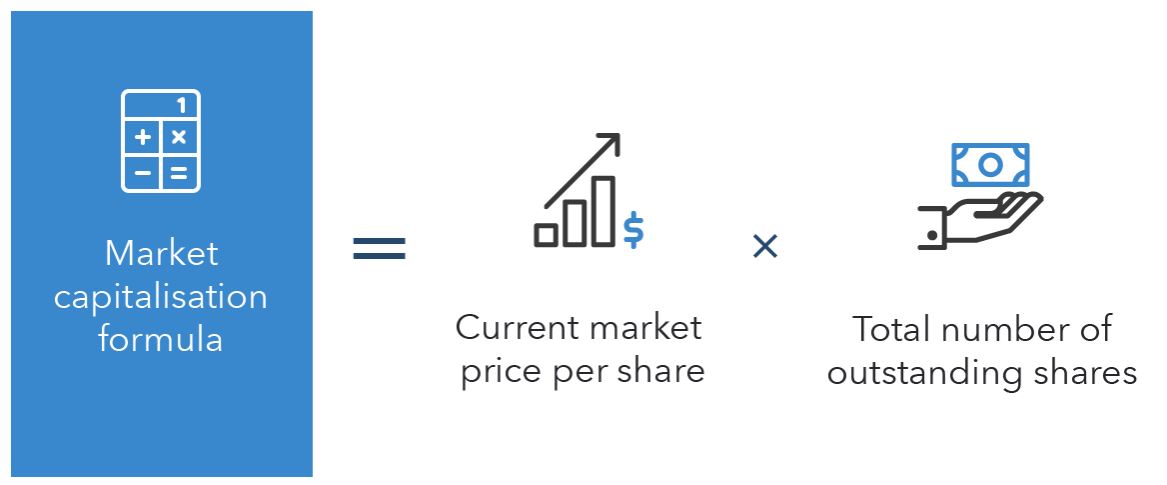
Market Capitalisation in simple terms is the value that is derived at by multiplying the total number of shares of a company by it's present share price value. This is also one of the easiest ways to value the worth of a company in the open market.

In the stock market, weights are assigned to companies based on it's value of Market Capitalisation. Companies are assigned as Large Cap, Mid Cap, Small Cap based on the Market Capitalisation. There are even made up classifications such as Mega Cap, Micro Cap, Nano Cap based on the market size.

Market Size Definition:
The common definition of Market Size is as follows:
Mega Cap: Companies with Market Capitalisation of greater than 200 Billion Dollars (>200Billion$)
Large Cap: Companies with Market Capitalisation of greater than 10 Billion Dollars (>10Billion$ <200Billion$)
Mid Cap: Market Capitalisation of above 2 Billion and lower than 10 Billion Dollars (>2Billion$ < 10Billion$)
Small Cap: Market Capitalisation of up to 2 Billion (>300Million$ <2Billion$)
Micro Cap: Market Capitalisation between 50 Million to 300 Million Dollars (>50Million$ < 300Million$)
Nano Cap: Market Capitalisation below 50 Million Dollars (<50Million$)

From an Indian perspective, stocks are defined in Lakhs and Crores and is as follows:
Mega Cap: Companies with Market Capitalisation greater than 1 Lakh Crores (>1Lakh Crores)
Large Cap: Companies with Market Capitalisation of greater than 20,000 Crores (>20000 Crores <1 Lakh Crores)
Mid Cap: Market Capitalisation of above 5000 Crores and lower than 20,000 Crores (>5000 Crores <20000 Crores)
Small Cap: Market Capitalisation of up to 5000 Crores (>500 Crores <5000 Crores)
Micro Cap: Market Capitalisation between 100 to 500 Crores (>100 Crores <500 Crores)
Nano Cap: Market Capitalisation of less than 100 Crores (<100 Crores)

The above classifications are broadly approximations and may tend to change over a period of time. In India, the broad usage is only with respect to Large, Medium and Small. Very Large can also be equated as Mega and can include companies belonging to the Nifty 50 index such as Reliance, TCS, HDFC Bank, ITC etc. Micro Cap are also termed as Penny stocks.

Stock Type Classification:
Stocks by themselves are also classified into different types based on it's history and the opportunities it derives and provides in the market. Let's look in brief at some of the popular types which gives an idea to the shareholder as to what they are venturing into:

- Blue Chip Stocks: These are usually large cap stocks that are leaders in their particular sector and have a solid history of long term growth performance
- Dividend or Income Stocks: These are stocks with a track record of regularly paying dividends to the shareholders
- Defensive Stocks: These are stocks that tend to be less sensitive to varied market conditions. They are those that do not get swayed much by the volatility prevailing and are the safer bets in times of crisis.
- Growth Stocks: These are stocks that are expected to grow rapidly in the future horizon with respect to earnings and revenue. They are expected to grow at a faster rate compared to the broader market
- Value Stocks: These are stocks that trade at a discount to what a company's performance actually indicates. Hence these are seen as potential value un lockers as they are attractively priced 
- Cyclical Stocks: These are stocks that tend to get affected by the changes in the overall market. They can be seasonal in nature and tend to perform better when market conditions are favorable to it's sector
- Penny Stocks: These are stocks with price trading at a single digit and known to be volatile
- IPO Stocks: These are stocks which get issued through an initial public offering.  They can get listed either at a premium or discount and it's performance is tracked significantly once they are listed
- ESG Stocks: It is expanded as environmental, social and governance stocks and these emphasize mainly on environmental protection, social justice and ethical management practices. These are the stocks that focus on carbon emission and renewable energy measures
- Common or Ordinary Stocks: These stocks entitle shareholders to generated profits and voting rights but have rights to a company's assets in liquidation only after preferred stock shareholders
- Preferred Stocks: These stocks entitle shareholders to generated profits but do not provide voting rights, however they get first preference to a company's assets when a company is dissolved or bankrupt

Market Capitalisation by Country:
In terms of countries with highest Market Capitalisation, the United States rules the roost accounting for more than half of the global market capitalisation of all the countries put together. Let's look below at the top 10 countries ranked by Market Capitalisation.

1) United States of America - 45 Trillion $
2) China - 6.5 Trillion $
3) Japan - 4.4 Trillion $
4) India - 3.1 Trillion $
5) United Kingdom - 3 Trillion $ 
6) France - 2.8 Trillion $
7) Saudi Arabia - 2.6 Trillion $
8) Canada - 2.4 Trillion $
9) Germany - 2.3 Trillion $
10) Switzerland - 2.1 Trillion $

This is the approximate market size of different countries as of June 2023 and may be subject to change. US however does not look to be displaced accounting for a majority of the global M-Cap. India recently pipped the UK to 4th position due to a surge in it's markets. Saudi Arabia is there on the list purely due to just one company - the oil and gas giant Saudi Aramco which rakes in more than 90% of the country's market capitalisation. In Europe, the 3 popular indices tracked include the DAX (Germany), FTSE (UK) and France (CAC).

Market Capitalisation - Largest Company By Country:
It would also be prudent to look at the top company contributing to Market Capitalisation in each of these countries:

1) United States of America - Apple - 2.8 Trillion $
2) China - Tencent - 408 Billion $
3) Japan - Toyota - 202 Billion $
4) India - Reliance - 203 Billion $
5) United Kingdom - Astra Zeneca - 230 Billion $ 
6) France - Louis Vuitton Moet Hennessy - 441 Billion $
7) Saudi Arabia - Saudi Aramco - 2.1 Trillion $
8) Canada - Royal Bank of Canada - 129 Billion $
9) Germany - SAP - 155 Billion $
10) Switzerland - Nestle - 321 Billion $

Thus, if you see Apple alone based on it's Market Capitalisation is far greater than numerous countries combined Market Capitalisation. In US, there are catchy terminologies used to describe a set of tech heavy stocks such as FAANG (Facebook, Apple, Amazon, Netflix, Google), MAAMA (Meta, Apple, Amazon, Microsoft, Alphabet). In France, the top 4 companies all happen to be luxury brands viz LVMH, L'oreal, Hermes and Dior whereas in UK companies from different sectors make up the list such as Astra Zeneca, Shell, HSBC, Unilever, Diageo etc. Japan has auto companies like Toyota, Mitsubishi on its coveted list so does Germany with the likes of Porsche, Mercedes, BWM in it's list of most valued companies.  

Market Capitalisation by Sector:
A sector is that section of the stock market which represents a particular industry. Through this it would be possible to know the outcome as to which company stocks happen to be market leaders within a specified environment. There are broadly 11 sectors that make up the slice of the overall stock market as per the Global Industry Classification Standard. These sectors can include many sub industries within its ambit. Lets look at the 11 different sectors and the company fighting for bragging rights as per value of Market Capitalisation within these sectors on a global scale.

1) Communication Services –  Alphabet (Google) - 1.6 Trillion $
2) Consumer DiscretionaryAmazon - 1.2 Trillion $
3) Consumer StaplesWalmart - 412 Billion $
4) EnergySaudi Aramco - 2.1 Trillion $
5) FinancialsBerkshire Hathaway - 733 Billion $
6) HealthcareUnited Health - 459 Billion $
7) IndustrialsUnited Parcel Services - 143 Billion $
8) Information TechnologyApple - 2.8 Trillion $
9) MaterialsBHP Group - 151 Billion $
10) Real EstatePrologis - 112 Billion $
11) UtilitiesNextera Energy - 149 Billion $

The sectors mentioned above are at the highest parent level and underneath this there are plenty of sub classifications such as for instance Industrials Sector containing Airlines, Airports, Courier Services, Construction and a host of other sub industries. Similarly Financials will include Banks, Insurances, Brokerages etc. One problem with the metric of Market Capitalisation is the fact that it fails to consider diversified businesses. For instance a company like ITC is not only in to Tobacco but also in the hotel business as well as consumer goods segment. Since M-Cap is just derived at by using the number of shares and price of share, there is no way to look at the contribution of market value of each of the sub-sectors. The only way to understand in such cases is by digging deep into the annual report to consider the businesses performed by different segments of a company.

Companies with Highest Market Capitalisation:
Listed below are the companies that possess highest value of Market Capitalisation globally

1) Apple - 2.8 Trillion $
2) Microsoft - 2.4 Trillion $
3) Saudi Aramco - 2.1 Trillion $
4) Alphabet (Google) - 1.6 Trillion $
5) Amazon - 1.2 Trillion $
6) Nvidia - 0.95 Trillion $
7) Tesla - 0.77 Trillion $
8) Berkshire Hathway - 0.73 Trillion $
9) Meta (Facebook) - 0.69 Trillion $
10) TSMC (Taiwan Semiconductor Manufacturing Company) - 0.53 Trillion $

Out of this above list, 8 of the 10 belong to USA with Saudi Aramco and TSMC owned by Saudi Arabia and Taiwan respectively making up the remaining. This list however keeps undergoing a change and can alter often based on the Market Capitalisation value going upwards or dropping. Companies like Visa, United Health, J&J which were earlier part of the top 10 most valued have slipped. Facebook has made a re-entry and at one time slipped even below 20 in the rankings.

There have however been only 8 companies ever to reach the monumental mark of 1 Trillion Dollar Market Capitalisation at anytime during their journey and it includes Apple, Microsoft, Saudi Aramco, Alphabet, Amazon, Facebook, Tesla, Nvidia. Nvidia was the latest entrant to this landmark before falling off a bit. Facebook and Tesla are still a far cry from their highest point reached. Apple is the only company to have touched a value of 3 Trillion Dollars although it has receded from it's peak but however it holds bragging rights in being the first corporation ever to summit the scale of 1Trillion$, 2Trillion$ and 3Trillion$ Market Capitalisation respectively.

Saturday, May 20, 2023

The Motions of the Planets and the Retrograde Effect

When seen from the perspective of an astrological horoscope, the Geo Centric theme acts as the key reference point. It is based on the assumption of keeping the apparent reference of Earth as the center point with all the planets revolving around it. Thus it is important to know the effect of how different planets affect while transitioning around the zodiac signs based upon keeping Earth as the base. However in reality as per the onus of the solar system it's always the planets circulating around the sun in the order of Mercury, Venus, Earth, Mars, Jupiter, Saturn, Uranus, Neptune and Pluto. 

As Earth is taken as the base, we generally consider Mercury and Venus as inner planets whereas Mars, Jupiter and Saturn are considered as outer planets to the Earth's orbit. Uranus, Neptune and Pluto which are much further away are not considered within the parlance of Vedic Astrology but in essence they also need to be seen as outer planets. The Sun and the Moon which is revolving around the Earth are considered as the luminaries emitting source of light and have a significant role to play in the charter of a horoscope. They signify the soul and the mind respectively and play a crucial role in the decoding of a horoscope. In fact the Ascendant sign (the sign rising in the Eastern Horizon when an individual takes birth / event takes place), the Sun sign and the Moon sign are considered as the Big 3 in a horoscope and are extremely essential in deriving a number of areas to study within a horoscope. Their use both as individual points as well as a reference point based on which other planetary configurations are studied can exhibit wide avenues of analysis within the purview of a horoscope.

Daily Motion of Planets
Let's go about ascertaining the average motion of planets viewed in from the Earth's geo centric perspective. Though they all revolve around the Sun, we consider the center of the Earth as the base point and determine the movement travelled by the various planets when circulating around the Sun in the solar system. Please do note this is more or less the average daily speed whereas actual speeds can vary on a given day, depending on when a planet turns stationary and moves between direct and retrograde motion. Also listing down the highest and lowest daily speeds for those available cases. 

Sun
Average Speed : 00°59'08"
Highest Speed :  01°03'00"
Lowest Speed :  00°57'10"

Moon
Average Speed : 13°10'35"
Highest Speed : 16°30'00"
Lowest Speed :  11°45'36"

Mars
Average Speed :  00°31'27"
Highest Speed :   00°52'00"
Lowest Speed : −00°26'12"

Mercury
Average Speed :  01°23'00"
Highest Speed :   02°25'00"
Lowest Speed : −01°30'00"

Jupiter
Average Speed :  00°04'59"
Highest Speed :  00°15'40"
Lowest Speed : −00°08'50"

Venus
Average Speed :  01°12'00"
Highest Speed :  01°22'00"
Lowest Speed : −00°41'12"

Saturn
Average Speed :  00°02'01"
Highest Speed :  08°48'00"
Lowest Speed : −00°05'30"

Though planets further than Saturn are considered within the purview of Vedic Astrology, documenting below the speeds of the planets much further from the Earth such as Uranus, Neptune and Pluto for the purpose of reference

Uranus
Average Speed :  00°00'42"
Highest Speed :  00°04'00"
Lowest Speed : −00°02'40"

Neptune
Average Speed :  00°00'24"
Highest Speed :  00°02'25"
Lowest Speed : −00°01'45"

Pluto
Average Speed :  00°00'15"
Highest Speed :  00°02'30"
Lowest Speed : −00°01'48"

When it comes to the nodes Rahu and Ketu, they normally transit in a reverse direction as seen from the Earth's parlance and their average daily motion is documented below:

Rahu
Average Speed :  −00°03'00"

Ketu
Average Speed :  −00°03'00"

For the purpose of a horoscope, the Ascendant plays a massively important role and this is deduced based on Earth's own rotation around it's axis which approximately takes about 23 hours 56 minutes and 4.09 seconds to cover the full span of 360°. Hence on an average day of 24 hours we can say that the Earth rotates 360° plus about an additional degree for the remaining about 4 minutes after completing one full rotation

Earth (For Ascendant)
Average Speed : 361°00'00"

Speed Order of Planets
Thus, when looked at the speed order, we can easily decipher that the Ascendant is the fastest being able to cover the entire paradigm of 360° covering all the zodiac signs in a day. This is followed by the Moon which covers on an average an entire Nakshatra span of 13°20'00". It covers the entire 27 Nakshatras spread across the 12 zodiac signs in just a little over 27 days. These are followed by the monthly planets viz Mercury, Venus and Sun all of which transit a zodiac sign in about a month's time. Then it is followed by the bi-monthly planet Mars which roughly transits a sign around once every two odd months. After this comes Jupiter which approximately transits in a zodiac sign for a period of a year. Then comes the nodes Rahu & Ketu which stay in a sign for roughly a year and a half and finally rounding up is Saturn which transits in a zodiac sign for a period of 2 and half years. One of the pertinent reasons why the planets Uranus, Neptune and Pluto are eliminated from the ambit of Vedic Astrology could be the fact that they take a very long time to complete a full round of the zodiac with these planets approximately taking about 84 years, 148 years and 236 years to complete one full cycle. That could be a potential reason as to why the impact may not be of much significance when seen from an individual horoscope as their transit time is exceedingly large.

Retrograde Motion
While studying the motion of planets, it is extremely prudent to also take into account the phenomena of the retrograde effect. Retrograde may mean moving backwards but in essence the planets don't really head backwards while revolving around the Sun in the solar system. But since we are looking at the movement of planets from the Earth's perspective, certain planets appear to be going backwards causing this phenomena. It in fact needs to be titled to as apparent retrograde motion since it's factored from the Earth's angle. The most widely used example of understanding this phenomena is by considering 2 parallel trains. For those placed in the faster train, it gives an illusory appearance of the slower train moving backwards and going in the opposite direction but in essence that's not the case and it is only moving slowly. This happens when the planets revolve around the Sun and undergo velocity changes at different paths in it's movement.

When considering Vedic Astrology, the Sun and Moon only move in the forward direction and do ever come into the picture of getting retrograde. The Rahu and Ketu almost always go in the reverse direction and hence they more or less always tend to be retrograde. Rahu and Ketu are mathematical pointers that arise when the orbit of the Moon cuts the ecliptic. True nodes tend to wobble around a bit causing some tilt in the opposite direction whereas Mean nodes always only tend to be retrograde as it's averaged out and calculated at a constant speed. For all practical purposes, we can safely consider Rahu & Ketu to be in retrograde motion most of the time. When it comes to the other 5 planets mainly in Vedic Astrology, we can split them as inner planets to Earth comprising of Mercury & Venus and the outer planets to the earth consisting of Mars, Jupiter and Saturn. These planets tend to go retrograde at different times based on their varying velocity while orbiting in the solar system. This is the reason you would associate a negative sign when marking the slowest speed of these planets.

Types of Motions
As per the Geo - centric model, these 5 planets undergo 8 types of movement which are as below:

Direct Motion:

1) Manda - Direct and quickening or constant daily motion but somewhat slow moving

2) Mandatara - Direct and slowing or constant daily motion but very slow moving

3) Shiigra or Chara - Direct and slowing or constant daily motion but fast moving

4) Shiigratara or Atichara - Direct and quickening or constant daily motion but very fast moving

5) Kutila or Vikala - Planet is in a stationary motion which equates to defective/deficient motion

6) Sama - Direct and even comprising of smooth constant motion

Retrograde Motion:

7) Vakra - Moving backward quickly relative to its attainable daily daily speed

8) Anuvakra - Moving backward slowly relative to its attainable daily daily speed

The sequence of planets getting retrograde happen based on the following order:

- Kutila or Vikala - Planets are stationery

- Manda - Planets slow down but are in direct and quickening motion

- Sama - Planets are direct and in even motion

- Shiigratara or Atichara - Planets are in direct and quickening motion, or constant but fast

- Sama - Planets are in direct and even motion

- Shiigra or Chara - Planets are in direct and slowing motion, or constant but fast

- Mandatara - Plantets are direct and slowing, or constant but slow

- Kutila or Vikala - Planets are stationery

- Anu Vakra - Planets are retrograde but slow

- Vakra - Planets are retrograde but fast

- Anu Vakra - Planets are retrograde but slow

- Kutila - Planets become stationery again

Retrograde in Horoscope 
Planets as we have seen become retrograde due to the relative speed undergoing a change during their motion in orbiting the Sun as seen from the lens of the Earth. Thus, planets in retrograde are generally said to be closer to the Earth and further off from the Sun. This holds especially true for the outer planets Mars, Jupiter and Saturn and we tend to manually ascertain if a planet is retrograde just by seeing how many houses it's moved away from the Sun. When it comes to Venus & Mercury, they always tail gate with the Sun and this doesn't really hold true of it being farther off from the Sun and closer to Earth. Mercury and Venus becomes retrograde when it appears to move backward as seen from the planet Earth. Generally when Mars, Jupiter and Saturn are placed in the 5th, 6th, 7th, 8th and 9th houses from the Sun they tend to get retrograde with Mars being retrograde when placed approximately 140° from the Sun, Jupiter about 115° from the Sun and Saturn about 110° from the Sun.

Listed below are the approximate days in which the planets become retrograde:

Mercury - It takes approximately 88 days to orbit around the Sun. Goes into retrograde motion about 3 to 4 times in a year and lasts roughly for around 24 days (3-4 weeks)

Venus - It takes approximately 225 days to orbit around the Sun. Goes into retrograde motion once in about 18 months and lasts roughly for around 50 days (7 weeks)

Mars - It takes approximately 687 days to orbit around the Sun. Goes into retrograde motion once in about 26 months and lasts roughly for around 74 days (2.5 months)

Jupiter - It takes approximately 4333 days to orbit around the Sun. Goes into retrograde motion once in about 9 months and lasts roughly for around 122 days (4 months)

Saturn - It takes approximately 10756 days to orbit around the Sun. Goes into retrograde motion once in about a year and lasts roughly for around 140 days (4.5 to 5 months)

Vedic Astrology Perspective of Retrograde Planets
As per Vedic Astrology, planets in Retrograde mention are said to get Chesta Bala as per the six fold Shad Bala calculation in ascertaining strength of planets. Thus if the planets are in retrograde motion, they are said to be strong and powerful. When it comes to results, Retrograde can be loosely translated as crooked (Vakri) and these planets can tend to give results much against their usual nature. It can work two ways and thus expected beneficial attainment can turn into negative attainment and vice versa. Working with Retrograde planets can be a little bit tricky as it's not really easy to judge their results but however it needs to be remembered always that planets in retrograde motion are much stronger than when they are in direct motion.

Wednesday, May 10, 2023

The Earth Centric Model and the Latitude Longitude Coordinates

A point of reference plays a very vital role within the ambit of a horoscope. When measuring distances or ascertaining directions, we always assimilate the same based on a central point and do the evaluation. Likewise when viewing the position of planets in the sky, it is imperative to know where they are located and their co-ordinates from a particular reference point. Without a reference object, it wouldn't really matter how further they are positioned in the sky or make any sense as to the impact effected by them. 

In the parlance of a horoscope, it is always the Earth which acts as the central pivot based on which planetary longitudes and latitudes are computed and the impact caused by them based on their placement in different signs and houses. This is in effect the main reason we do not see the 'Earth' being marked in any horoscope is because it's always from the Earth that the effect of other planets are deduced. If of course one wants to know the position of Earth, it would be located exactly 180 degrees from the Sun's position in a particular horoscope.

Reference Centric Models 
There are different theories and models circulated for estimating the position of planets from a particular reference point. Lets briefly look at the different reference centric models

- Geocentric Model
This is an Earth centric model. As per this model, it is assumed that earth is at the center of the universe and all the planets including the Sun revolve around it. In this model, geo centric positions are calculated with respect to the center of the earth. Geo is alternatively used as a term to describe Earth.

- Topocentric Model
This is an Earth centric model. In this model also, it is assumed that earth is at the center of the universe and all the planets including the Sun revolves around it. However in this model, the positions of planets including Sun are calculated with respect to the observers location which can be the actual place of birth of an individual or at the epicentre of where an event has taken place.

- Heliocentric Model
This is a Sun centric model. In this model, it is assumed that the Sun is at the center of the universe and all the other planets including the Earth revolves around it. Helios is another name for Sun and hence appropriately named so.

- Planetocentric Model
This is a planet centric model. In this model, a particular planet is assumed as the reference point with other planets including the Earth and Sun revolving around it. This is mostly adopted with the planet Mars being the source of reference and deducing the position of all other planets including Sun and Earth.

- Barycentric Model
This is a solar system centric model. Barycenter is defined as the center of a mass. In this model, a point in the solar system is considered as the reference and establishes the coordinates of all the other planets including Sun and Earth. 

There has been a perennial debate whether its the Earth that revolves around the Sun or whether it's the Sun that revolves around the Earth. Astronomers after numerous research and evidence have finally concluded that it's the latter which holds true. Hence the real picture that takes place in the skies is the Heliocentric model where all planets including the Earth revolves around the Sun.

However we cannot overlook the fact that human beings are born on earth and major events take place on Earth. So it is prudent and makes extra sense to view it with reference to the point of view of Earth. Planetocentric and Barycentric models are basically documented for academic purposes and Heliocentric though it accounts for the real perspective of keeping Sun at the center, it doesn't hold ground at least from an horoscopic angle as all things concerned are looked at with respect to the Earth as the base point.  

Thus, while looking at it from a horoscope standpoint, it is the Geocentric or Topocentric model which is used when computing planetary coordinates. In all the astrology software's and even almanacs, it is the Geocentric position that is used at vogue which is the methodology of accounting for planetary coordinates keeping the center of the Earth as the base point. The center of the Earth falls at the Royal Observatory in Greenwich, United Kingdom which falls at a longitude of 0 degrees. Greenwich was universally chosen to be the Prime Meridien of the World in 1884. The Royal Observatory is the source of the Prime Meridian of the world with Longitude of 0° 0' 0''. The prime meridian marks the divide between the eastern and western hemispheres.
Thus irrespective of where one takes birth whether it happens to be east of Greenwich say India or the western side of Greenwich say United States, planetary coordinates will not differ as they are all determined using Greenwich as the central reference point. However there is one important position in a horoscope which is used as the starting reference point known as the Ascendant and this is obtained as the point that is rising on the eastern horizon based on the observers location. Hence lets say person A was born in India at 3PM and person B is born in the United States also at 3PM. Though the planetary positions will remain more or less the same as in both cases as they are determined using Greenwich as the central location, however the Ascendant will undergo a change as the point rising in the Eastern horizon in India will be different from that of the United States. The House counting system is usually done by taking the Ascendant as the base and this will have a major say in the referencing of a Horoscope.

Also one of the major basis for the Geocentric system is that all planetary positions need to be calculated based on a fixed reference point on Earth and it's center position happens to be the only fixed point on the Earth's surface. If we take any other point based on observer's location, it cannot hold to be a fixed common point as the Earth's surface is always moving due to it's rotational movement around it's axis. Planetary coordinates don't really change taking either of Geocentric or Topocentric positions sans the Moon alone. In the case of the Moon, there tends to be a difference by about a degree and this can change the outcome of a horoscope in a major way. The deviation tends to be maximum when Moon is placed near to the Ascendant or in the opposite 7th house and is minimum when positioned near to the 4th or 10th house. Moon's position is especially used while computing Dasa Balance at birth and this could alter proceedings in a major way. However the general norm is that Moon's position is also calculated based on Geocentric position since Moon revolves around the center of the Earth and not just any point on the Earth's surface. However this point should be kept in mind in determining the analysis of a horoscope since it can end up having quite a major impact.

When it comes to determining the Ascendant, it is important to reference the latitude and longitude of the place on earth where an individual is born or an event has taken place. The Latitude and Longitudes combine to form grids which are key for locating places on the earth and arriving at the coordinate position. These are certain imaginary lines drawn on the earth that enables to precisely decode selective places located on planet Earth. The Earth as such is defined as a 'Geoid' meaning that it is slightly flattened at the North & South pole and bulged in the middle. This makes the earth's equatorial diameter as 12756 kms (West to East) whereas it's polar diameter is 12714 kms (North to South). Let's look at a few important snippets with respect to the imaginary lines that are drawn on the earth namely the Latitude and Longitude.

Latitudes:
- Latitudes also called 'Parallels' are horizontal lines that run from the West to the East across the Earth
- The most important Latitude line is the Equator which divides the Earth equally into two halves viz the Northern Hemisphere and the Southern Hemisphere
- The Northern most point of the Earth is termed as the North Pole and the Southern most point of the Earth is called as the South Pole. The lines drawn above the equator are called North Latitudes and lines below the equator are called South Latitudes. It should however be noted that the Latitude lines are not of equal length.
- Latitudes measure the distances in degrees starting with the equator at 0 degrees. They go up the equator marked from 1 to 90 degrees all the way to the North Pole and likewise go down the equator marked from -1 to -90 degrees all the way to the South Pole. The numbers in positive indicate that they are part of the Northern Hemisphere and the numbers in negative indicate they belong to the Southern Hemisphere. Alternatively they can also be coded with the acronym as North and South. Eg +30 degrees in North can be written as 30°N and -30 degrees in South can be denoted as 30°S.
- The other important Latitude lines are the Tropic of Cancer & Arctic Circle located in the Northern Hemisphere and the Tropic of Capricorn & Antarctic Circle located in the Southern Hemisphere. These help to define climatic zones based on the different quotients of sunlight received throughout the year. The Tropic of Cancer is at 23° 26' N and the Arctic Circle is at 66° 34' N whereas the Tropic of Capricorn is at 23° 26' S and the Arctic Circle is at 66° 34' S. Generally they are stated as being 23 and a half and 66 and a half degrees North and South respectively.
- The portion from Equator to Tropic of Cancer in the Northern Hemisphere and Equator to Tropic of Capricorn in the Southern Hemisphere are called 'Torrid Zones'. This is the place where maximum sunlight gets received. The portion from the Tropic of Cancer to Arctic Circle in Northern Hemisphere and from Tropic of Capricorn to Antarctic Circle in Southern Hemisphere are termed 'Temperate Zones'.They are of moderate climate and experience 4 different seasons. The portion from Arctic Circle to the North Pole in Northern Hemisphere and between the Antarctic Circle to the South Pole in Southern Hemisphere is known as the 'Frigid Zone'. These usually experience cold climate as they are placed in an angle that receives very less sunlight.

Longitudes:
- Longitudes also called 'Meridians' are vertical lines that run from the North to the South across the Earth
- The most important Longitude line is the Prime Meridian which divides the Earth equally into two halves viz the Western Hemisphere and the Eastern Hemisphere
- Longitudes measure the distances in degrees starting with the Prime Meridien at 0 degrees. The lines to the right of the Prime Meridian are marked from 1 to 180 degrees all the way to the East and the lines to the left of the Prime Meridian are marked from -1 to -180 degrees all the way to the West. The numbers in positive indicate that they are part of the Eastern Hemisphere and the numbers in negative indicate they belong to the Western Hemisphere. Alternatively they can also be coded with the acronym as East and West. Eg +120 degrees in East can be written as 120°E and -120 degrees in West can be denoted as 120°W.
- The lines of the Longitude help in determining time zones across the globe because when it's day in one of the hemispheres, it's night in the other hemisphere and vice versa. It should however be noted that unlike Latitude lines, Longitude lines happen to be of equal length.
- The 0° longitude which passes through Greenwich is considered as the historic Prime Meridian of the World and all the time zones across the globe are calculated with reference to this. The 180° longitude line to the West and East of the Prime Meridien is termed as the Anti Meridian or the International Date Line.
- The Earth rotates 360° in about 24 hours which equates to 15° for every hour and for every 4 minutes. Hence if time at Greenwich is 12 noon, a place that is 15° to the East would be one hour ahead which would equate to 1PM and a place that is 15° to the West would be one hour behind which would be 11AM. This is also the basis for AM and PM which translates as Ante Meridiem and Post Meridiem where AM refers to before midday and PM identifies with after midday. Thus the A.M (or morning time) is the time before the sun passed meridian and P.M (or afternoon time) is the time after the sun has passed meridian at noon
- Based on the lines of longitude , 24 of them have been marked as standard meridians. Taking Prime Meridian as 0° longitude, the longitudes at 15° intervals are known as Standard Meridians. Hence on the East of the Prime Meridian there are 12 time zones and on the West of the Prime Meridian there are another 12 time zones (180° divided by 15° standard)

Time is decided according to movement of the Earth. Based on this different places have day and night occurring at varying time periods. If there were no time zones prevalent and if every place adopted the same universal time, it would be 6AM in one part of the world and fully Sunny and yet be 6AM in another part of the world and be completely dark. It is usually perceived that the dawn of Sun to be a signifier of morning activities and accordingly Sunrise time is adopted as the morning time in different places and the setting of Sun is considered as evening time in different places. As the Earth rotates from West to East, the places East of the Prime Meridien are those that receive the light of the Sun first and those places to the West of the Prime Meridien receive the light much later on. That is the reason you would see places like Australia, New Zealand, Japan etc gaining time compared to places in the United States, Canada etc which are losing time.

Though there are countries with places which are spread across different standard meridians, it's not always the case that different places within a country adopt different time zones. One example being India which universally adopts a Standard Meridian of  82°30' East based on the Meridian line which passes through Prayagraj in Uttar Pradesh giving rise to Indian Standard Time being 5 and half hours or 330 minutes ahead of Greenwich (82 degrees*4 minutes per degree + 0.5 degrees*4 minutes per degree =328 + 2 = 330 minutes). Thus time in every place in India will be the same irrespective of whether it's in the West or East of India. India also doesn't adopt the concept of Day Light Savings Time which is the practise of advancing clock time during the warmer months so that darkness falls at a later clock time. There are however countries like USA, Russia etc who make use of different time zones and also rake in the concept of day light savings time.

However from an Ascendant calculation point of view, it is important to know the Longitude and Latitude of a place as it is determined based on the degree which is rising in the eastern horizon. Taking India as an illustration, every place in India will have a latitude in the North since it is located above the equator in the Northern Hemisphere and likewise every place will have a longitude in the East as it is located towards the right side of the Prime Meridien. For instance, the recorded time maybe the same in both Mumbai & Chennai at any point of time but the Sun rises much earlier in Chennai being in the South of India which is located at about 80° East of the Prime Meridian as compared to a Mumbai which is placed in the West of India at about 72° East of the Prime Meridian. Hence this needs to be factored in the determination of Ascendant. Also when it comes to accuracy and precision, knowing the exact longitude and latitude of the place of birth of an individual  or occurrence of an event also could have a bearing. For instance every nook and corner within a locality may not be of the same latitude and longitude but in many cases we tend to denote an entire city as having the same coordinates. This could lead to some minor discrepancy when determining the exact degree of the Ascendant. For instance an area like Mylapore in Chennai may have coordinated at a slight alteration to the general coordinate which is adopted for Chennai. It would be ideal and more precise if these little matters also be taken care of in order to attain more pin point precision.


Thursday, May 4, 2023

The Motions of the Earth and the effect of Sidereal, Solar and Synodic Time Periods

There are 3 kinds of motion associated with the Earth namely which are:
- Rotation
- Revolution
- Precession


It is to be noted that the Earth rotates around it's own axis constantly along with also revolving around the Sun. There is also a third motion which happens very minutely that is known as procession. The Earth wobbles around it's axis which tilts it's relative position to the background stars by approximately 50 seconds a year. This effect of the wobble causes the earth to shift about 1 degree in a span of 72 years (1 degree = 3600 seconds divided by 50 seconds wobble). Applying some mathematics, we can infer that the Earth's axis gets shifted by 180 degrees in 12960 years (72 years for 1 degree multiplied by 180) and to return back to it's original position of 360 degrees takes roughly 25920 years (72 years for 1 degree multiplied by 360). 

This wobbling effect though very minor in nature since it is only barely 50 seconds for a year is not considered within the parlance of Tropical Zodiac and that is the whole reason why sun sign dates differs between the Indian and Western system. The Indian Vedic system adopts the Sidereal Zodiac that takes into account the Wobble effect whereas the Western system takes only the Tropical Zodiac not factoring the Wobbling impact of the Earth. The debate is however endless with respect to the time period in which the wobbling effect started to take place which gives rise to the phenomenon called 'Ayanamsa' which is defined as the angle by which the sidereal ecliptic of a celestial body is less than its tropical ecliptic longitude.

The consensus currently is that Earth has shifted around 24 degrees from its initial position and that is the reason why we see about 24 days difference between the two zodiacs. For instance, the common belief is that the Sun enters the sign of Sagittarius around 22nd of November but the month of Margazhi which is Sun's movement into the sign of Dhanus or Sagittarius occurs only around 16th December as per the almanacs published. The difference will only expand as time keeps travelling but the thing to be noted is that the dates of the Tropical Zodiac will remain more or less constant whereas it's only the dates in the Sidereal Zodiac that will undergo a change of roughly about a day once in every 72 years.

Another important point to keep track is the time taken by the Earth to revolve around the Sun. We know that one year constitutes of 365 days and a leap year is added once every 4 years to make the tally as 366 days. This is because the Earth takes about 365.2422 days to traverse 360 degrees around the Sun. This extra quarter of 0.25 over and above 365 days is added as an extra day once every 4 years (0.25*4 = 1 day) to bridge for this gap. For all practical purposes, a year cannot consist of days in decimals and hence a conventional year is accounted only as 365 days with a leap year of 366 days thrown in once every 4 years. Also it can be noted that Earth revolves about a degree a day around the Sun (365 days for 360 degrees) with the average mean motion of the Earth around the Sun being accounted for about 59 Min 8 seconds in a day.

Lets take a look at some important terminologies with respect to Earth's motion:

Sidereal Day: A Sidereal Day is the time taken by Earth to rotate around it's axis with respect to the stars. This takes about 23 hours 56 minutes and 4.09 seconds.
Sidereal Day = 23 Hours, 56 Minutes, 4.09 Seconds or 0.997270 Days

Solar Day or Tropical Day: A solar day is the time it takes for the Earth to rotate about its axis so that the Sun appears in the same position in the sky. We know a day consists of 24 hours with the time taken by Earth to rotate around it's axis being 23 hours, 56 minutes and 4 seconds. We also know that the Earth revolves around the Sun. To complete a solar day, Earth must rotate an additional portion equal to 1/365 of a full turn. The time required for this extra rotation is 1/365 of a day is approximately close to about 4 minutes. Thus a Solar Day is recorded as 24 hours.
Solar Day = 24 Hours or 1 Day

Synodic Day or Lunar Day: This basically equates to a 'Tithi' within an Indian parlance and denotes the angular distance formed between the Sun and Moon. The Earth revolves around the Sun and the Moon traverses across the Earth's orbit. Since the motions of the Sun and Moon are always varying in speed, the length of a tithi constantly changes and can alternate between 19 hours to 26 hours. However the mean length considered is 24 hours based on the solar time.
Synodic Day = 24 Hours or 1 Day

Sidereal Month: A Sidereal month is the time needed for the Moon to return to the same place against the background of the stars. The Moon revolves around the Earth and takes approximately a little over 27 days to return back to it's orbit. The average daily motion of the moon is said to be about 13 degrees 10 minutes and 35 seconds and to transgress 360 degrees around the Earth is said to take about 27.32 days (360 degrees divided by 13 degrees, 10 minutes and 35 seconds). In Vedic Astrology, the constellations are divided into 27 types of Stars or Nakshatras with each having a time span of 13 degrees 20 minutes. Thus it could be configured that on an average, a Nakshatra span lasts a little over one day considering the daily mean motion of Moon is 13°10'35'' whereas time duration associated with a Nakshatra happens to be 13° 20''.
Sidereal Month = 27 Days, 7 Hours, 43 Minutes, 11.5 Seconds or 27.321661 Days

Solar Month: A solar month is derived based on a Calendar year which consists of 365 days and a leap year added once every 4 years making it 366 days. We know there are 12 months in a year and dividing it by 365 or 366 results in about 30.5 days per month. However for practical purposes we do not normally round the days in a month and the standard days in a month is taken as 30. However some of the months do also have 31 days with February having the least with 28 in normal years and 29 during a leap year.
Solar Month = 30 Days

Synodic or Lunar Month: A Lunar month is considered to be the time period between one full moon to another full moon or one new moon to another new moon. This is based on the relative reference of the Sun and Moon with Earth being the binding factor. Taking the Sun and Moon to be in the exact same position, we already know that a Sidereal month takes approximate 27.32 days. By the time the Moon takes this time to make one path on the Earth's orbit, the Earth would have motioned around 27 degrees towards the Sun. (Since Earth's motion around the Sun is about a degree a day or more precisely 59 min 8 seconds per day). While the Moon is orbiting Earth, the Earth is progressing in its orbit around Sun. After completing a sidereal month, the Moon must move a little further to catch up with the new position having the same angular distance from the Sun. Therefore, a Lunar month takes about 2.2 days longer than a sidereal month making a Lunar Month approx 29 and a half days in length.
Synodic Month = 29 Days 12 Hours 44 Minutes 2.9 Seconds or 29.530589 Days

Sidereal Year: A Sidereal Year is the time that Earth takes to orbit the Sun and return to the same position in relation to the background of the stars. It takes into account the precession caused by the wobbling of the earth and hence it takes about 20 minutes longer than a Tropical year which does not factor into account the effect of precession.
Sidereal Year = 365 Days, 6 Hours, 9 Minutes, 9.5 Seconds or 365.256364 Days

Solar Year or Tropical Year: A Solar Year or Tropical Year which is also known as the Year of the Seasons is the time it takes the Earth to complete a full orbit around the Sun. However while deriving the measure of a Tropical year, the axial tilt of the earth caused due to it's wobbling nature is not considered into account making it slightly shorter in duration than a Sidereal Year.
Solar Year = 365 Days, 5 Hours, 48 Minutes, 46.43 Seconds or 365.242189 Days

Synodic or Lunar Year: A Synodic or Lunar Year is based on the monthly phases of the Moon's cycle which constitutes the relationship based upon the angular distance between Sun and Moon. We have seen that a Lunar month lasts about 29 and a half days and hence to cover 12 cycles will take on an average of about 10-11 days less than a calendar year of 365 days. The number of Lunar months in a Solar Year is said to be about 12.36827.
Synodic Year = 354 Days, 8 Hours, 48 Minutes, 34 Seconds or 354.367060 Days  

Based on the motions of the Earth, the following can also be summarized briefly:
Rotation of the Earth causes the Day and Night Phenomena
The Earth rotates from West to East and one side of the Earth faces the Sun causing day light and the other side gets obscured from the rays of the Sun causing darkness. The Rotation of the Earth also determines the Ascendant in a Horoscope which is the point on the eastern horizon when an individual takes birth. The Ascendant has a direct correlation with the Sun. The Sun rises in the East which dawns a new beginning. In the default Kalapurusha chart, the first sign Aries which also happens to be the exalted sign for Sun is said to denote the Eastern direction. Also the Sages have attributed Sun to be the significator for the first house of birth manifestation.

Revolution of the Earth causes Seasons
As the earth rotates on its axis producing day and night, it also moves about the sun in an elliptical orbit that requires about 365 1/4 days to complete. The earth's axis is tilted with respect to its orbital plane which is what causes the seasons. When the earth's axis points towards the sun, it is summer for that hemisphere. When the earth's axis points away, winter can be expected. Since the tilt of the axis is 23 1/2 degrees, the North Pole never points directly at the Sun, but on the summer solstice it points as close as it can, and on the winter solstice as far as it can. Midway between these two times, in spring and autumn, the spin axis of the earth points 90 degrees away from the sun. This means that during this period, day and night have more or less about the same length of 12 hours.
                           

-> Summer Solstice : Jun 20-22 - Sun reaches it's northern most point when North Pole tilts closest to the Sun - Northern Hemisphere experiences longer days & shorter nights - Southern Hemisphere experiences shorter days & longer nights

-> Winter Solstice : Dec 21-22 - Sun reaches it's southern most point when South Pole tilts closest to the Sun - Northern Hemisphere experiences shorter days & longer nights - Southern Hemisphere experiences longer days & shorter nights

-> Vernal or Spring Equinox : Mar 20-21 - Sun moves northward across the celestial equator with the North Pole starting to tilt towards the Sun indicating climate starting to get hotter in the Northern Hemisphere. Northern Hemisphere experiences Spring with days & nights being equal - Southern Hemisphere experiences Autumn with days & nights being equal.

-> Autumn Equinox : Sep 22-23 - Sun moves southward across the celestial equator with the South Pole starting to tilt towards the Sun indicating climate to start getting hotter in the Southern Hemisphere. Northern Hemisphere experiences Autumn with days & nights being equal - Southern Hemisphere experiences Spring with days & nights being equal.

Note: Autumn always comes after summer season and spring follows winter season. In autumn, the temperature gradually decreases and in spring the temperature starts increasing. The Autumnal Equinox is related to the autumn season and the term vernal equinox is related to the spring season


Additionally, it would also be a subject matter of interest to know about the concepts of Perihelion and Aphelion. Perihelion or Periapsis occurs when Earth moves closest to the Sun which takes place around 1st week of January every year whereas Aphelion or Apoapsis is when Earth moves furthest away from the Sun and this takes place around the first week of July every year.
                               

Precession of the Earth causes Ayanamsa or Precision of Equinoxes
As the Earth wobbles around it's axis, it leads to an axial tilt creating the effect of Ayanamsa which leads to the formation of Sidereal Zodiac based upon the backdrop of the stars as opposed to the Tropical Zodiac which causes seasons and does not factor the wobbling effect into it's equation.

Monday, April 24, 2023

The type of Yogas and the Muhurtha Yogas

Yoga within a broad terminology can reflect to mean joining or a fusion of elements to create a particular effect. It is believed that the word Yoga originated from the Sanskrit root 'Yuj' which means to join properly, control judicially or to integrate. The combination at play produces effects which can be both effective or ineffective as well as auspicious or inauspicious.

Within the parlance of Vedic Astrology, Yoga's can be categorised into 3 types:

- Planetary Yogas:  These Yogas get formed when a planet, sign, or house is related to another by placement, aspect or conjunction.

- Nithya Yogas: These are Yogas that occur based on the angular distance of the Sun and Moon. This is considered as one of the 5 limbs of Panchanga. The degrees of Sun and Moon are summed up and every 13° 20' forms a Nithya Yoga and there are a total of 27 Yogas in total. These are also termed as Dina Yoga (Daily) or Surya Adhi Yoga since it takes place based on the relationship prevalent between the Sun and the Moon.

- Muhurtha Yogas: These are Yogas that take place based on the combination of one or more elements from the Panchanga viz Vara & Nakshatra, Vara & Tithi, Vara, Nakshatra & Tithi together etc. These are usually time periods foreseen for performing or avoiding any activity.  

Within the framework of a horoscope, it's the planetary yogas which usually gains supremacy. There can be multiple forms of planetary conjunctions or relationship formation between planets placed in different houses from each other. The Sages have mentioned a number of yogas which are popularly viewed at in a horoscope such as Gajakesari Yoga, Buddha Aditya Yoga, Anabha Yoga, Sunabha Yoga, Kemadruma Yoga, Vasumathi Yoga etc. The list of such Yogas are infinite and the classics do give a reference to many of these Yogas.

The Nithya Yogas are only 27 in number and they form part of one of the five legs of Panchanga. There is a result attributed to each of the Yogas that one is born in along with also giving rise to a Yogi planet and an Avayogi planet which is said to prosper and mar prospects respectively depending on their placement in a horoscope.

The Muhurtha Yogas formed are the one's which are said to indicate a favourable or unfavourable time period when performing a particular activity. It is not so much relatable to one's individual horoscope but however the Muhurtha Yogas formed during birth can give a broad overview about the progress or course of action in a natives life. When one takes birth at the time a Muhurtha Yoga is in operation can denote an auspicious or inauspicious birth. It is however more related to choosing the time period for undertaking different tasks. This article will take a look at the different Muhurtha Yogas that are prevalent.

The Muhurtha Yogas take place largely based on the combination of Vara + Nakshatra, Vara + Tithi, Tithi + Nakshatra, Vara + Tithi + Nakshatra.

-> Vara + Nakshatra Yogas

Amrithadhi Yoga
One of the Yogas which is predominantly mentioned in most Panchangas happen to be the Amrithadhi Yogas. These are classified into 4 categories namely - Siddha Yoga, Amrita Yoga, Marana Yoga and Prabalarishta Yoga. The former two are seen in positive light whereas the latter two denote a lot of negativity and hence it is better to avoid any important tasks when these Yogas are in operation. These Yogas get formed as a result of a combination of the factor of Vara and Nakshatra. Let's briefly look at the meaning of these 4 Yogas

Siddha Yoga - The term Siddha connotes accomplishment. Thus whenever Siddha Yoga occurs, it is said to be auspicious. 
Amrita Yoga - The word Amrita is said to denote immortality, priceless etc. It can also said to be a period of elixir or nectar inducing. Thus any activity performed in Amrita Yoga is said to be benevolent and beneficial.
Marana Yoga - This is said to indicate a painful or killing like situation. Hence during the time period when this Yoga is in operation, it is said to avoid any important tasks. However routine and day to day activities can be performed.
Prabalarishta Yoga - This is a Yoga that is said to be highly inauspicious. It is said to attract a lot of negativity and induce varied ill effects. Hence it is ideal to avoid any sort of activity during the time this Yoga is in operation.

The Amritadhi Yogas which are a combination of Siddha, Amrita, Marana and Prabalarishta occurs based on the following Vara & Nakshatra combination. 


Amrita Siddha Yoga
On top of the Amrithadhi Yogas mentioned above which individually produces Siddha, Amrita, Marana and Prabalarishta Yoga based on the combination at play between Vara & Nakshatra, there is also an Amrita Siddha Yoga which occurs based on specific combination of a particular Nakshatra occuring on a particular day. Since this is a combination of both Siddha & Amrita, it is said to be very auspicious and even more beneficial when producing effects compared to the individual Siddha Yoga or Amrita Yoga. Listed below is the combination of Vara and Nakshatra which produces this Yoga
Sunday - Hastha
Monday - Mrigasheerisham / Mrigashira
Tuesday - Ashwini
Wednesday - Anusham / Anuradha
Thursday - Poosam / Pushya
Friday - Revathi
Saturday - Rohini

Though Amrita Siddha Yoga is said to be outright favourable, it is mentioned to avoid the following specific activities when it is in operation.
Marriage on Thursday Poosam / Pushya 
House Warming Ceremony (Graha Pravesha) on Tuesday Ashwini
Travelling on Saturday Rohini

Mrityu Yoga
There has already been a mention of the Marana Yoga and Prabalarishta Yoga as part of the Amritadhi Yogas which are said to be inauspicious. There is also a Muhurat based Yoga called Mrityu Yoga which again results based on a combination of Vara & Nakshatra. This is said to be a worrying time period to an intolerable degree and can be harmful. Listed below is  the combination of Vara and Nakshatra which produces this Yoga
Sunday - Anusham / Anuradha
Monday - Uthiradam / Uttara Ashada
Tuesday - Sadayam / Satabisha
Wednesday - Ashwini
Thursday - Mrigasheerisham / Mrigashira
Friday - Kettai / Jyesthta
Saturday - Hastham / Hastha

Daghda Yoga
Daghda is equivalent to Shoonya and denotes a curse. A particular combination of Vara + Nakshatra ends up yielding this particular Yoga which is said to be inauspicious. It should be noted that majority of the combinations pertaining to Daghda Yoga is in line with Prabalarishta Yoga indicating harmful effects. Listed below is the combination of Vara and Nakshatra which produces this Yoga
Sunday - Bharani
Monday - Chithirai / Chitra
Tuesday - Uthiradam / Uttara Ashada
Wednesday - Avittam / Dhanishta
Thursday - Uthiram / Uttara Phalguni
Friday - Aayilyam / Ashlesha
Saturday - Revathi

Yamaghata Yoga
This again is an inauspicious Yoga that arises based on the occurrence of a Nakshatra on a selected Vara. This is said to act as a hurdle when carrying out any important task. Yama is the signifier of death and Ghata relates to reduction, loss or deficiency. Hence it is to be tread with caution when such a Yoga is in operation as any work carried out during this period may not bode well.
Sunday - Magam / Magha
Monday - Tiruvadirai / Arudra
Tuesday - Visagam / Vishakha
Wednesday - Moolam / Moola
Thursday - Karthigai / Krithika
Friday - Rohini
Saturday - Hastham / Hastha

Utpata Yoga
This is said to have a tearing out effect and is another Yoga of the negative kind. This occurs based on the following combinations
Sunday - Visagam / Vishakha
Monday - Pooradam / Poorva Ashada
Tuesday - Avittam / Dhanishta
Wednesday - Revathi
Thursday - Rohini
Friday - Poosam / Pushta
Saturday - Uthiram / Uttara Phalguni

Determining Type of Yoga based on count of Vara + Nakshatra
There is a method of ascertaining the Yoga associated on a particular day through a counting formula inherited based on the Vara and Nakshatra. This can be used as a check point when carrying out any important activity.

As per this methodology, the 27 Nakshatras  should be counted from a particular Nakshatra assigned for each day. The order of Nakshatra counting should be performed based on the Vara in operation as assigned below:
Sunday - Visagam / Vishakha
Monday - Pooradam / Poorva Ashada
Tuesday - Avittam / Dhanishta
Wednesday - Revathi
Thursday - Rohini
Friday - Poosam / Pushya
Saturday - Uthiram / Uttara Phalguni

As an illustration, let's say the current day is Thursday and the Nakshatra in transit is Bharani. For Thursday, the counting starts from Rohini. Hence we need to count the number of Nakshatras from Rohini to Bharani both inclusive. The total arrived at should be divided by 7. When we count from Rohini to Bharani, the arrived count is 26 and when divided by 7 we obtain a reminder of 5. Based on the reminder, the following Yogas are formed:
1 - Iruthai Yoga (Darkness)
2 - Nasa Yoga (Spoilt)
3 - Marana Yoga (Death)
4 - Amrita Yoga (Nectar)
5 - Shubha Yoga (Auspicious)
6 - Siddha Yoga (Accomplished)
7 - Parigha Yoga (Obstruction)

Determining Nature of Activity Yoga based on Vara + Nakshatra
There are certain Nakshatras which are said to be associated with a particular nature and are deemed to be even more favorable when they coincide with a particular Vara. Let us look at the combinations for such cases:
Sthira Nakshatras - Fixed - For activities that require fixity such as laying foundation. Eg. coronation, sowing seeds etc. They are also called as Dhruva Nakshatras.
Sunday - Rohini, Uthiram / Uttara Phalguni, Uthiradam / Uttara Ashada, Utharattathi / Uttara Bhadrapada

Chara Nakshatras - Movable - For activities that require movement. Eg. riding vehicles, undertaking any journey etc.
Monday - Punarpoosam / Punarvasu, Swati, Tiruvonam / Shravana, Avittam / Dhanishta, Sadayam / Satabisha

Ugra Nakshatras - Cruel - For activities involving violence, force. Eg. demolishing structures, breaking things, acting with force etc.
Tuesday - Bharani, Magam / Magha, Pooram / Poorva Phalgunu, Pooradam / Poorva Ashada, Pooratathi / Poova Bhadrapada

Misra Nakshatras - Mixed - For activities involving a mixed variety or things involving duality. Eg. Performing worshipping, engaging in ceremonies, fabricating etc
Wednesday - Karthigai / Krithika, Visagam / Vishakha

Laghu Nakshatras - Swift - For activities involving swiftness or quick action. Ideal for those that do not sustain for long. Eg. involving in pleasures, wearing jewellery, work with quick decision making etc. They are also called as Shipra Nakshatras.
Thursday - Ashwini, Poosam / Pushya, Hastham / Hastha, Abhijit

Mridu Nakshatras - Tender - For activities involving learning something new, undertaking any subtle activities etc. Eg enrolling for classes, making friends, learning fine arts etc
Friday - Mrigaseerisham / Mrigashira, Chithirai / Chitra, Anusham / Anuradha, Revathi

Tikshana Nakshatras - Sharp - For activities involving bitterness, deceit etc. Eg. invoking spirits, plotting against enemies, committing unrealistic deeds etc
Saturday -  Tiruvadirai / Aarudra, Aayilyam / Ashlesha, Kettai / Jyeshta, Moolam / Moola

-> Vara + Tithi Yogas

Siddha Yoga
Like the Siddha Yoga which takes place based on the Vara + Nakshatra combination, there is a Siddha Yoga which also takes place between Vara + Tithi matching. Siddha Yoga occurs based on the below mentioned combinations
Sunday - None
Monday - None
Tuesday - Jaya Tithis (3,8,13) - Tritiya, Ashtami, Trayodashi
Wednesday - Bhadra Tithis (2,7,12) - Dwitiya, Saptami, Dwadashi
Thursday - Poorna Tithis (5,10,15) - Panchami, Dashami, Pournami or Ammavasya
Friday - Nandha Tithis (1,6,11) - Pratipada or Pratamai, Sasthi, Ekadashi
Saturday - Riktha Tithis (4,9,14) - Chaturthi, Navami, Chaturdashi

Amrita Yoga
This also takes place on similar lines based on a Vara + Tithi combination and arises based on below:
Sunday - Nandha Tithis (1,6,11) - Pratipada or Pratamai, Sasthi, Ekadashi
Monday - Bhadra Tithis (2,7,12) - Dwitiya, Saptami, Dwadashi
Tuesday - Nandha Tithis (1,6,11) - Pratipada or Pratamai, Sasthi, Ekadashi
Wednesday - Jaya Tithis (3,8,13) - Tritiya, Ashtami, Trayodashi
Thursday - Riktha Tithis (4,9,14) - Chaturthi, Navami, Chaturdashi
Friday - Bhadra Tithis (2,7,12) - Dwitiya, Saptami, Dwadashi
Saturday - Poorna Tithis (5,10,15) - Panchami, Dashami, Pournami or Ammavasya

Krakacha Yoga
This is termed as the 'Saw' and is said to be of a splitting effect causing things to break apart. This happens based on the following combinations
Sunday - Dwadashi
Monday - Ekadashi
Tuesday - Dashami
Wednesday - Navami
Thursday - Ashtami
Friday - Sapthami
Saturday - Sashti

Daghda Yoga
This is a cursed yoga and happens based on the below combinations. Couple of the references for Sunday and Monday are on similar lines to Krakacha Yoga
Sunday - Dwadashi
Monday - Ekadashi
Tuesday - Panchami
Wednesday - Dwitiya & Tritiya
Thursday - Sashti
Friday - Ashtami
Saturday - Navami

Hutasana Yoga
This again is an inauspicious Yoga. Said to be fiery by nature, it is said to cause negativity when commencing any new activity. This arises based on below combination
Sunday - Dwadashi
Monday - Sashti
Tuesday - Sapthami
Wednesday - Ashtami
Thursday - Navami
Friday - Dashami
Saturday - Ekadashi

Visha Yoga
This as the name connotes means poisonous and again attracts a time of misgivings and hence should be avoided. It arises based on the below:
Sunday - Chaturthi
Monday - Sashti
Tuesday - Sapthami
Wednesday - Dwitiya
Thursday - Ashtami
Friday - Navami
Saturday - Sapthami

Adham Yoga
The meaning of this is very dark and denotes the colour black. Hence it is another inauspicious Yoga being caused and arises based on the below:
Sunday - Saptami, Dwadashi
Monday - Ekadashi
Tuesday - Dashami
Wednesday - Pratipada, Navami
Thursday - Ashtami
Friday - Sapthami
Saturday - Sashti

Samartaka Yoga
This refers to dissolution and again denotes in-auspiciousness. This occurs based on the below:
Sunday - Sapthami
Wednesday - Pratipada
 
-> Tithi + Nakshatra Yoga

Asubha Yoga
This arises purely based on a particular combination of Nakshatra and Tithi. This is not said to be propitious and said to occur for the following options
Pratipada - Uthiradam / Uttara Ashada
Dwitiya - Anusham / Anuradha
Tritiya - Uthiram/UttaraPhalguni, Uthiradam / Uttara Ashada, Uthirattathi / Uttara Bhadrapada
Panchami - Magam / Magha
Sashti - Rohini
Sapthami - Hastham / Hastha, Moolam / Moola
Ashtami - Pooratathi / Poorva Bhadrapada
Navami - Karthigai / Krithika
Ekadashi - Rohini
Dwadashi - Aayilyam / Ashlesha
Trayodashi - Chitthirai / Chitra, Swati

-> Vara + Tithi + Nakshatra Yoga

Dwipushkar Yoga
Any event which is said to take place in this Yoga has the tendency of getting doubled or occurring more than once. Hence only those activities should be selected which is beneficial when repetition occurs. This occurs based on following combinations
Sunday - Dwitiya - Avittam / Dhanishta
Tuesday - Sapthami - Chitthirai / Chitra
Saturday - Dwadashi - Margashira / Mrigasheerisham

Tripushkar Yoga
Any event in this Yoga is said to recur twice or more. Hence favourable events can be initiated that can tend to result in growth matters. This occurs based on following combinations
Sunday - Dwitiya - Karthigai / Krithika
Tuesday - Sapthami - Punarpoosam / Punarvasu
Saturday - Dwadashi - Uthiram, Uthiradam, Uthirattathi, Visagam

Conclusion:
These are a bird's eye view of some of the popular Muhurtha Yogas that are prevalent. It is not practically possible to keep a track of them all and if one tends to follow all these minutely then almost no particular activity can ever take place. The Yoga's listed themselves are not comprehensive by any stretch and there is a lot more kind of Muhurtha yogas occurring based on even more different combinations. However among the popular kind of Yogas, it may be helpful to follow the list that take place at least within the scope of Amrithadhi Yogas which is listed in many popular almanacs along with the Siddha Yogas that are believed to be fortunate and auspicious when taking place within the respective Vara + Tithi combination.